Girl names dads love: a meaning-first shortlist
A dad’s shortlist of girl names that pass the park test, the register and the job application, with what each one means and where it comes from.
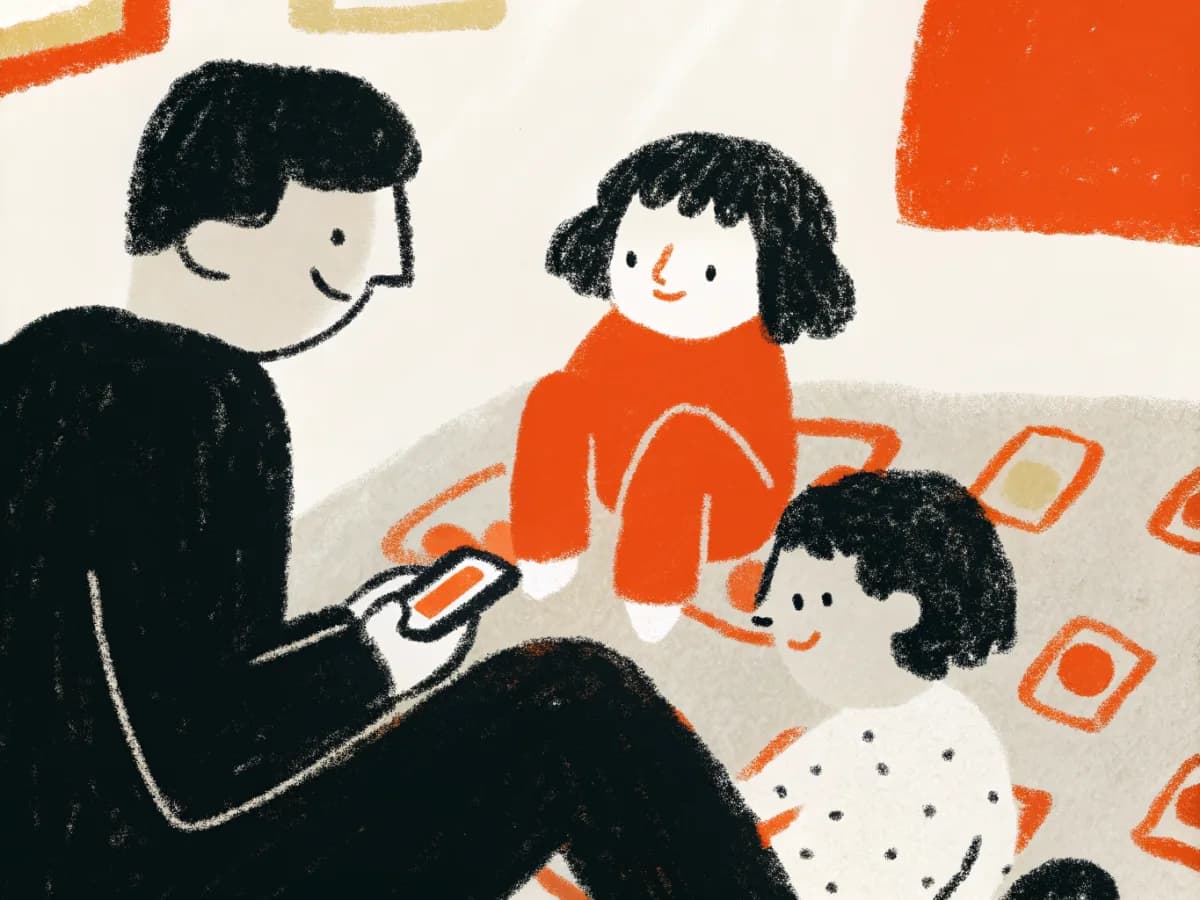
A present dad is one who gives his kids his full attention in the small, ordinary moments, not one who clears his diary for grand gestures. Presence beats quantity every time. Ten minutes where you put the phone down and actually look at your kid does more than a whole Saturday spent in the same room but somewhere else in your head.
That is the good news, because most of us do not have endless spare hours. You have the school run, the ten minutes before tea, the gap at bedtime. The habits below are built for that life. None of them need a free weekend, a big budget or a personality transplant. They just need you to show up, on purpose, in the time you already have.
Being a present dad means your kids feel that they have your attention when they are with you. It is less about hours logged and more about whether they sense you are really there, listening and noticing, rather than half-watching them while your mind is on work or your phone.
Kids are very good at telling the difference. They know when you are nodding along and when you are actually listening. Presence is the thing they feel in their gut: Dad sees me, Dad has time for me, I matter to him right now. You build that feeling not in one big talk but in hundreds of tiny moments, repeated, until it becomes the background hum of how they understand you.
The Harvard Center on the Developing Child talks about serve-and-return, the back-and-forth between a child and a caring adult. The child serves, a babble, a question, a drawing held up, and the adult returns it with attention and a response. That simple loop, done often, is one of the most powerful things you can do for a developing brain. You do not need a course in it. You just need to return the serve instead of letting it drop.
Presence matters more than hours because children remember how you made them feel, not how long you sat in the room. A short stretch of full attention lands deeper than a long stretch of distracted company, and it is far easier to fit into a busy week.
Think about your own childhood. The memories that stuck are rarely the expensive days out. They are small: a dad who listened to a daft story all the way to the end, who came to the thing that mattered, who noticed you were quiet and asked why. Those moments cost almost nothing in time. They cost attention, which is the thing we are all stingiest with.
This is freeing if you work hard or do not live with your kids full time. You are not in a losing race against the dads with more hours. You are in a completely winnable game about what you do with the hours you have got. A present dad with thirty good minutes a day beats an absent-in-the-room dad with all evening, every time.
Pick fixed phone-down windows and protect them like appointments. The most important ones are the school run, mealtimes and bedtime. In those windows the phone goes in another room or in your pocket on silent, not face-up on the table where it pulls your eyes every time it lights up.
The phone is the single biggest thief of presence for most dads, and the hardest habit to fix, because it is designed to win. You will not beat it with willpower alone. You beat it with rules that make the right thing the easy thing.
The point is not to become a monk. It is to make sure that when your kid looks up and wants you, they find your face and not the top of your head bent over a screen.
Anchor presence to fixed daily touchpoints rather than trying to find big blocks of free time. A reliable ten minutes at the same moment each day, the morning, the pickup, the bedtime story, builds more security than an occasional big day out, because children trust what is predictable.
Long hours are a real constraint, not an excuse to feel guilty about. The trick is to stop measuring yourself by total time and start protecting a few small, dependable anchors that your kid can count on.
The Fathering Project, an organisation that supports dads, makes the same point: it is the quality and consistency of the connection that counts, not a heroic quantity of hours. Consistency is something a busy dad can absolutely deliver.
Create small, repeatable rituals that belong to just you and one child, the same activity at the same regular time, so it becomes a thing they look forward to and rely on. It does not need to be special on paper. The magic is that it is predictable and it is yours.
A ritual is just a habit with a bit of meaning attached. Because it repeats, your kid knows it is coming, and that anticipation is half the gift. It also gives each child a turn at having you to themselves, which matters enormously if you have more than one.
These rituals do the quiet work of telling each child: you, specifically, are worth my time. That message, repeated for years, is the bedrock of a confident kid.
Treat the school run and bedtime as your two daily golden windows and protect them from the phone and the rush. They bookend the day, they happen anyway, and a child is often at their most talkative in the car or in the dark, when there is no eye contact to make it feel like an interrogation.
These two slots are gold precisely because they are already in your routine. You do not have to find the time. You just have to be properly there inside it.
On the school run, kill the radio sometimes and let the quiet do its work. Kids will fill a comfortable silence with whatever is on their mind. Resist the urge to lecture or to use the captive time for admin about homework and shoes. Just be company. Ask an open question and then let them talk.
At bedtime, slow down. Bedtime is when small worries surface, and a child who feels rushed will swallow them. Sit on the edge of the bed for an extra two minutes. Lights low, voices quiet. You will be amazed what gets said in the dark that would never get said across the kitchen.
Because most of the time your kid wants to be heard, not solved. When you leap in with a fix, you accidentally tell them their feeling was a problem to be cleared away. When you listen first, you tell them the feeling is allowed, and that you can handle it with them.
This one is hard for dads, because solving is how a lot of us show love. Your kid says something hurt them and every instinct fires up to fix it, to advise, to tell them it is not a big deal. Sit on that instinct.
A child who feels heard at six tells you things at sixteen. This habit is a long game, and it is one of the most valuable you will ever play. It runs right through everything, whether you are raising a confident daughter or a confident son.
Show up for the things that feel small to you but are enormous to them: the assembly, the match where they are a substitute, the drawing they want stuck on the fridge. Your presence at the unglamorous stuff says I am interested in your whole life, not just the highlights.
Kids keep a quiet tally of who turned up. They notice the empty seat. They notice the full one even more. You will not make every single thing, and that is fine, but make the effort visible and make the ones you promise.
None of this is grand. That is the entire point. The small stuff is where a child decides whether they matter to you.
Repair it. Go back, own your part plainly, and reconnect. Every dad snaps sometimes. What separates a present dad is not never losing his temper, it is being the one who comes back afterwards and puts it right, because that teaches a child that love survives a rough moment.
You will shout. You will be short and unfair when you are tired. This does not make you a bad dad. Pretending it did not happen, or waiting for them to get over it, is what does the damage. The repair is the bit that matters.
Done well, repair is a gift. It shows your child that conflict is survivable, that people who love each other fall out and come back, and that saying sorry is something strong people do. That is a lesson they will use for the rest of their lives.
Make your time predictable and child-led, and protect the connection between visits, not just during them. As a separated dad, presence is less about how many nights you get and more about whether your child experiences you as a steady, reliable presence they can count on, week in, week out.
This is a hard road and the guilt can be heavy. Try to set it down. Your kids do not need a perfect setup. They need to know that when it is your time, you are fully theirs, and that you are still in their life in the gaps.
Plenty of separated dads have rock-solid bonds with their kids. The ones who manage it are not the ones with the most generous arrangements. They are the ones who are utterly dependable and fully present in the time they have.
You will not get all of this right, and you do not need to. No dad does. Pick one habit from this list, the phone in the drawer at tea, the two minutes longer at bedtime, the walk on a Saturday, and just start there. Let it become normal, then add another. Your kids are not keeping score of your hours or grading your technique. They are simply working out, day by day, whether you are really there. Show up for the small stuff, come back when you get it wrong, and put the phone down when they look up. That is the whole job, and you are already closer to doing it than you think. If you fancy more in this vein, have a read of what it really means to be a girl dad.
Found this useful? We hand-pick indie brands for girl dads, and run our own little shop.
Keep reading
 Guides
A dad’s shortlist of girl names that pass the park test, the register and the job application, with what each one means and where it comes from.
 Guides
A dad’s guide to first phones and social media: trust, privacy, group chats, boundaries and what to do when something goes wrong.
 Guides
A calm, practical dad’s guide to talking with your daughter about puberty: body changes, questions, privacy and when to seek support.